
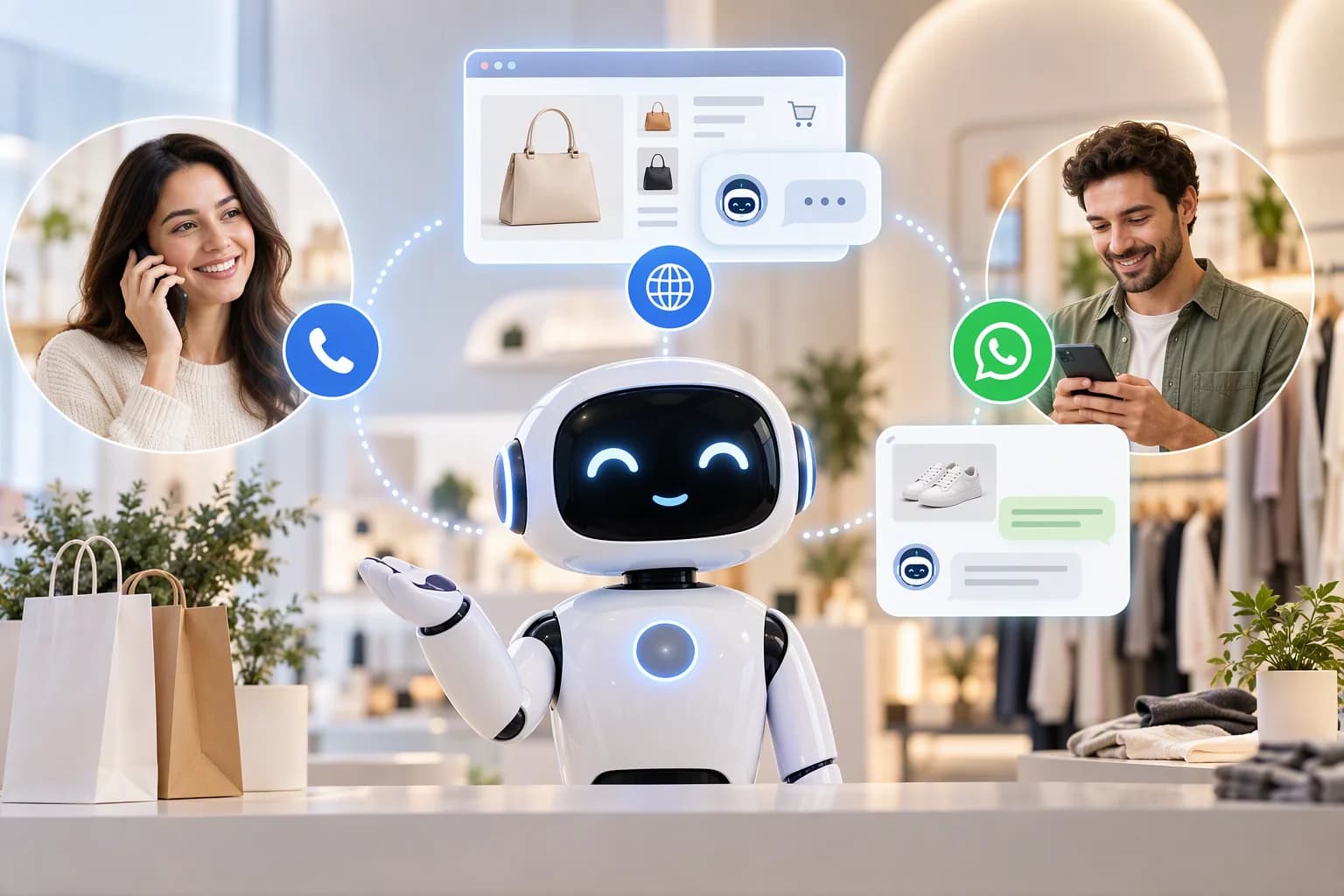
Retail AI Agents Improve Customer Service Across Calls, Websites, and WhatsApp
David M.
CEO, Woizer
</div>In short:
- Retail AI agents can handle repeatable questions about products, shipping, returns, store hours, and appointments.
- They need accurate product, policy, and service information to give dependable answers.
- Human escalation remains essential for complaints, payment matters, exceptions, and complex orders.
- Start with the questions your team receives most often, then expand only after reviewing real conversations.
What are retail AI agents and what do they do?
Retail AI agents are customer-service tools designed for shopping and retail conversations. Unlike a static FAQ page, they can interpret a question, use approved business information, ask relevant follow-up questions, and guide the shopper toward a next step.
That next step may be finding a product category, checking store hours, explaining a published return policy, booking an appointment, or reaching a member of your team. The agent can work through text, voice, or both, depending on the channel.
For example, a shopper may ask whether local pickup is available or need help understanding delivery options. The agent can provide the information your business has approved, collect relevant details, and escalate the request when a person needs to decide or act.
Common retail uses include:
- Answering product, shipping, return, and policy questions
- Guiding shoppers to relevant categories or pages
- Sharing store hours, locations, and pickup details
- Taking initial order or appointment requests
- Capturing leads and callback requests
- Escalating urgent, sensitive, or unusual conversations
An AI voice agent is particularly useful when inbound phone calls are a major part of the customer experience.
AI agents help retail teams respond faster without removing human service
Retail customers often contact a business when they are close to making a decision. They may need a product detail, delivery information, help comparing options, or confirmation of a return policy. When answers are delayed, shoppers may leave while staff are pulled away from in-store service, fulfillment, and higher-value consultations.
An AI agent provides a consistent first response for routine requests. It can answer repeated questions while employees focus on customers who need judgment, product expertise, or direct problem-solving.
The goal is not to automate every customer interaction. The goal is to make useful information easier to access and reserve staff time for conversations where people add the most value.
Retail AI agents work by combining approved information with clear workflows
An agent needs reliable source information and explicit boundaries. Product pages, store hours, shipping details, return rules, FAQs, and service descriptions form the basis for accurate responses. If the information is incomplete or outdated, the agent should not be expected to provide dependable answers.
Retailers should also define what the agent can answer, what information it may collect, and when it must transfer, notify, or create a follow-up task for a person.
On a website, an agent can support voice or text conversations. It may help visitors navigate pages, locate products, complete forms, or understand published policies. Strong product data matters here: Shopify, for example, documents how product details are managed in its product information guidance.
On the phone, a voice agent can answer common calls, identify the customer’s intent, collect order or appointment details, and send a summary to the appropriate team member.
On WhatsApp, an agent can respond to messages and voice notes for customers who prefer messaging. Retailers using WhatsApp should also follow the platform’s current WhatsApp Business Platform documentation.
Woizer provides AI agents for business phone calls and websites. Its phone agent can answer questions, book appointments, take order details, escalate urgent calls, and provide call recordings, transcripts, and summaries. The Website Agent supports voice and text conversations with website visitors.
See it work on your site
Paste your URL — get a working voice agent in 2 minutes. Free, no credit card.
The best retail tasks for AI agents are repeatable and clearly defined
AI agents are most effective when the request follows a repeatable pattern and the correct answer comes from information your business can define clearly. These are usually the questions employees answer throughout the day.
Useful retail tasks include:
- “What time do you close?”
- “Do you deliver to my area?”
- “What is your return policy?”
- “Do you offer local pickup?”
- “Which products are suitable for this use?”
- “Can I book a fitting, consultation, or pickup?”
- “Can someone contact me about a larger order?”
- “Where can I find this product category?”
Product discovery can also work well when the agent guides rather than guesses. It can ask about budget, intended use, preferences, or delivery needs, then direct the shopper to relevant categories or product pages.
The agent should not promise stock availability, discounts, delivery dates, refunds, or product suitability unless it has access to current, approved information. When a request depends on changing inventory or a staff decision, it should collect the details and escalate.
A retail AI workflow should answer, collect, escalate, or decline clearly
A useful workflow makes the agent’s role visible to both customers and staff. The following decision table provides a practical starting point.
| Customer request | Agent action | Information to collect | When to escalate or decline |
|---|---|---|---|
| Store hours, location, pickup rules | Answer from approved business information | None unless the customer requests follow-up | Escalate if hours or location details are unclear |
| Published shipping or return policy | Explain the published policy and link to the relevant page | Order reference if support is needed | Escalate refund requests, exceptions, or disputes |
| Product discovery | Ask about need, budget, style, or use case and guide to products | Preferences and contact details if requested | Escalate technical, custom, or high-consideration purchases |
| Appointment or pickup request | Gather requested date, time, and contact details | Name, contact method, requested service | Escalate if availability requires staff confirmation |
| Order request by phone | Collect product, quantity, delivery, and callback details | Customer and order details | Do not process payment details unless an approved secure process is in place |
| Complaint or delivery problem | Acknowledge the issue and capture the facts | Order number, contact details, summary | Escalate promptly to a trained team member |
| Legal, safety, or sensitive request | Avoid making decisions or promises | Only what is necessary for follow-up | Route to the responsible human team |
This structure prevents the agent from improvising outside its approved role and gives staff the context they need when they take over.
A strong setup starts with real customer conversations
The most useful starting point is not a generic automation goal. It is the calls, messages, and website questions your business already receives. Those interactions show where an agent can reduce repetitive work without creating unnecessary risk.
- Identify common customer questions. Start with products, delivery, returns, hours, appointments, and order requests.
- Choose the busiest channel. Focus first on the phone, website, or messaging channel creating the most pressure.
- Prepare accurate source information. Review product pages, policies, FAQs, service descriptions, and store details.
- Set escalation rules. Define when the agent should transfer a customer or create a follow-up request.
- Test realistic shopper requests. Include incomplete questions, unclear requests, complaints, and edge cases.
- Review conversations regularly. Look for unanswered questions, weak handoffs, and information that needs updating.
Woizer can build assistants from a business website, while businesses without a website can enter or speak their business information directly. Ongoing review still matters because products, policies, promotions, and business details change.
Chatbots, voice agents, and retail agents serve different customer channels
These terms overlap, but they describe different ways of supporting customers. For a broader comparison of channels and use cases, see this guide to AI customer service for small businesses.
| Tool type | Main channel | Typical retail role | Example |
|---|---|---|---|
| Traditional chatbot | Website text chat | Answers basic FAQs | Shares a return-policy page |
| AI voice agent | Phone calls | Handles spoken requests | Collects a pickup request |
| Website AI agent | Website voice and text | Supports product discovery and navigation | Helps a shopper find a category |
| WhatsApp AI agent | Messages and voice notes | Handles messaging support | Answers a shipping question |
| Retail AI agent | One or more channels | Supports shopping and service workflows | Routes a complex request to the right team |
When comparing options, focus on the customer journey rather than the label. A retailer receiving frequent calls needs reliable call handling. An ecommerce store may prioritize product navigation and messaging. Many businesses need both.
AI voice agents improve retail call handling when escalation is simple
Phone calls remain important for retailers selling higher-consideration products, offering local services, taking phone orders, or handling urgent requests. Calls often arrive while staff are helping customers in-store or preparing orders.
A useful voice flow identifies the caller’s purpose quickly. Is the caller asking about hours? Do they need delivery information? Are they requesting an appointment, placing an order, or reporting a problem?
The agent can answer straightforward questions, collect the details needed for follow-up, and route the call when a person needs to intervene. It should never trap customers in a loop or make it difficult to reach human support.
An AI voice agent is especially useful when customers browse online but call for reassurance before buying.
Retail AI agents require privacy controls and human review
Retail service conversations may involve names, phone numbers, addresses, order references, and other personal information. Collect only the information needed to handle the request, define who can access conversation records, and keep retention practices clear.
Payment information requires particular care. Do not ask an AI agent to collect or store card details unless your payment process is designed and approved for that purpose. Use a secure payment provider or transfer the customer to a trained team member when payment is required.
If calls are recorded or transcribed, tell callers where required and obtain consent when applicable. Recording and privacy rules vary by jurisdiction, so retailers should confirm their obligations with qualified legal or privacy professionals.
Human review is also essential. Staff should review escalated complaints, delivery failures, refund requests, unusual orders, and any conversation where the agent lacks verified information. Automation should support accountability, not remove it.
Retailers should avoid unsupported promises and set-and-forget automation
Retail information changes frequently. Products are discontinued, promotions end, holiday hours change, and policies are updated. An agent can only provide dependable answers when its sources and instructions remain current.
Avoid these issues:
- Incomplete business information: Product, FAQ, and policy content must be clear before the agent relies on it.
- Unverified promises: Do not allow guarantees about stock, delivery dates, refunds, discounts, or exceptions without a current approved source.
- Hidden human support: Customers need an obvious route to a person for complex or unresolved issues.
- Generic scripts: Retail questions are often informal, incomplete, and specific to a product or order.
- No conversation review: Review interactions to identify missed questions and weak escalation paths.
- Automating a broken process: Fix unclear shipping rules, returns, and product data before automating them.
The same standard applies whether you are using a voice platform, website assistant, or messaging agent.
The right platform supports your channels, information, and escalation process
A polished demo is not enough. The platform should use approved business information, support the actions customers need, and give your team control over updates and handoffs.
| Evaluation area | What to check |
|---|---|
| Customer channels | Phone, website voice, website text, WhatsApp, or a combination |
| Retail knowledge | Products, shipping, returns, hours, and FAQs |
| Customer actions | Navigation, appointment requests, order details, forms, and lead capture |
| Escalation | Ability to route urgent or complex conversations to the right person |
| Integrations | Website, CRM, calendar, messaging, and ecommerce platforms |
| Ongoing control | Ability to update content and instructions as the business changes |
A website assistant can support voice and text conversations, show products, add items to a cart, fill forms, and guide visitors to relevant pages. Wix store owners should ensure their product and inventory information is current before adding customer-facing automation.
FAQ
Can retail AI agents take orders over the phone?
They can support phone order-taking when the business has clearly defined what information to collect and how orders should be handled. An agent can gather product requests, quantities, delivery preferences, and callback details.
For complex orders, substitutions, payment questions, or special terms, the call should be transferred to trained staff.
Can an AI agent answer questions about returns and shipping?
Yes, when it has access to current return and shipping information. It can explain published policies, link customers to relevant pages, and collect details for a support request.
It should not promise refunds, policy exceptions, or delivery outcomes unless current business rules explicitly support those actions.
Do AI agents work with Shopify or Wix stores?
Some website agents can be installed on ecommerce platforms. Woizer’s Website Agent supports product discovery, cart assistance, form completion, and site navigation.
Before installation, make sure product pages, pricing, shipping information, and return policies are complete and current.
Build a better retail customer journey
Retail AI agents give shoppers faster access to useful information while helping your team focus on complex conversations and high-value service. Start with accurate business information, clear escalation rules, and the customer requests your team handles most often.
Explore the Woizer Website Agent to add voice and text assistance to your retail website.
See it work on your site
Paste your URL and get a working voice agent in 2 minutes. Free, no credit card.
Try it free →