
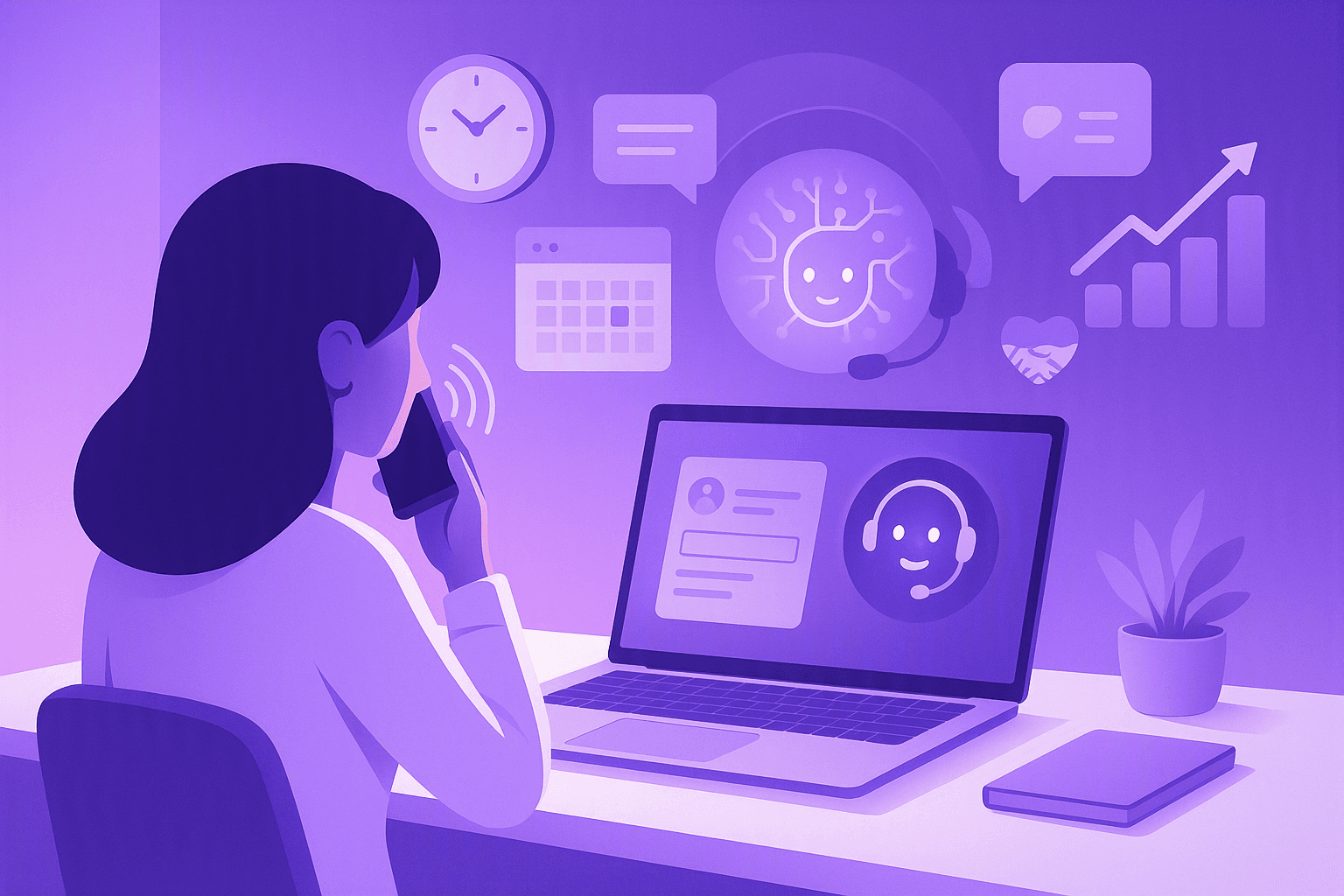
AI Voice Assistant for Small Business: The 2026 Guide
David M.
CEO, Woizer
AI Voice Assistant for Small Business: The 2026 Guide That Skips the Hype
Every small business owner knows the feeling: a potential customer calls at 7 PM, gets voicemail, and never calls back. Or a website visitor lands on your pricing page, has one question, and bounces because nobody's there to answer it.
An AI voice assistant for small business solves both of these problems — not in some theoretical future, but right now, with technology that actually works at the speed of conversation.
This guide covers what these systems do, how they differ from the chatbots you've been ignoring for five years, and how to get one running on your site or phone line in under ten minutes.
Key Takeaways
- AI voice assistants handle calls and website conversations 24/7 — no staff required, no voicemail boxes that customers ignore.
- Setup takes minutes, not months. Modern platforms scan your existing website and configure themselves. No developer needed.
- The technology has crossed the usability threshold. Sub-500ms response times mean conversations feel natural, not robotic.
- ROI is immediate and measurable — captured leads, booked appointments, and answered questions that would otherwise be lost.
What Is an AI Voice Assistant for Small Business?
Let's be precise. An AI voice assistant for small business is software that holds real-time voice conversations with your customers — either on your website, over the phone, or both. It understands natural language, responds in a human-like voice, and takes actions: booking appointments, answering product questions, routing urgent calls, capturing contact information.
This is not the same as:
- IVR phone trees ("Press 1 for sales, press 2 for support") — those are menu systems, not conversations.
- Text chatbots — those handle typed messages but can't speak or listen.
- Smart speakers — Alexa and Google Home are consumer products, not business tools.
The 2026 generation of AI voice assistants combines large language models with voice synthesis and speech recognition fast enough to feel like talking to a person. The difference between today's systems and what existed even two years ago is night and day in terms of response speed, comprehension, and voice quality.
What It Actually Does Day-to-Day
Here's what a typical week looks like for a small business running an AI voice assistant:
- Monday 9 PM: A homeowner visits your HVAC company's website. The voice agent asks what they need, explains your emergency service options, and books a Tuesday morning appointment — all by voice conversation on the site.
- Tuesday 6 AM: Someone calls your office before it opens. The phone agent answers, identifies it's a routine scheduling request, books the slot, and sends the customer an SMS confirmation.
- Wednesday 2 PM: A Spanish-speaking customer calls. The agent switches to Spanish mid-conversation and handles the entire interaction without a bilingual staff member present. (For more on this capability, see our guide to multilingual AI customer service.)
- Thursday all day: While you're on job sites, the agent handles 14 calls, qualifies 3 leads, and routes 1 emergency directly to your cell.
That's not a sales pitch — that's what these systems do when properly configured.
Why 2026 Is the Tipping Point
Three things converged to make AI voice assistants practical for small businesses this year:
1. Response Speed Dropped Below the Awkwardness Threshold
Early AI voice systems had 2-3 second delays between when you stopped speaking and when the AI responded. That felt terrible. People hung up. Current systems operate at under 500 milliseconds — fast enough that conversations flow naturally without uncomfortable pauses.
2. Setup Complexity Disappeared
In 2023-2024, deploying an AI voice agent meant weeks of configuration, custom development, and extensive training data. Now, the best platforms scan your existing website URL, learn your business information, services, hours, and policies automatically, and deploy a working agent in minutes.
3. Cost Reached Small Business Territory
Enterprise companies have used AI voice for years. What changed is pricing. Solutions now exist at price points that make sense for a 5-person dental practice or a solo plumber — not just Fortune 500 call centers.
See it work on your site
Paste your URL — get a working voice agent in 2 minutes. Free, no credit card.
The Two Deployment Models: Website vs. Phone
An AI voice assistant for small business typically works in one of two ways (or both):
Website Voice Agent
This is an AI agent embedded on your website that can speak with visitors, navigate them to relevant pages, highlight products, fill out forms, and capture leads. Think of it as a knowledgeable sales rep that lives on your site 24/7. For a deeper dive into this deployment model, check out our full guide on AI voice widgets for websites.
Best for:
- E-commerce sites where visitors need product guidance
- Service businesses with complex offerings (insurance, legal, financial)
- Any site where visitors frequently leave without converting
A good website voice agent doesn't just answer questions — it proactively engages visitors, guides them through your site's pages, clicks buttons on their behalf, and completes actions that drive revenue.
Phone Voice Agent
This is an AI system that answers your business phone line. It handles calls when you can't — after hours, during busy periods, or as a full-time receptionist replacement. It books appointments, answers FAQs, routes emergencies, and sends follow-up texts.
Best for:
- Businesses that miss calls regularly (the majority of small businesses)
- Companies paying for answering services they're unhappy with
- Anyone whose voicemail box is where leads go to die
A phone agent replaces the frustrating experience of voicemail with an actual conversation that resolves the customer's need in real time. If you're currently using a traditional answering service, our comparison of virtual receptionist solutions breaks down exactly where AI outperforms legacy options.
Real Use Cases by Industry
Home Services (Plumbing, HVAC, Electrical, Landscaping)
The problem: You're on a job. Phone rings. You can't answer. Customer calls the next company on Google.
The solution: AI phone agent answers, determines urgency, books non-emergency appointments into your calendar, and immediately texts you about genuine emergencies.
One HVAC company found that the majority of their missed calls never called back. An AI voice assistant for home services captures those leads automatically.
Dental and Medical Practices
The problem: Front desk staff spends half their day on the phone handling appointment scheduling, insurance questions, and cancellations. Patients calling after 5 PM get voicemail and often book elsewhere.
The solution: AI handles scheduling, confirms insurance networks, manages cancellations and rebooking — all by natural voice conversation. Works 24/7.
Dental practices using AI voice assistants report significant reductions in front-desk phone time, freeing staff for in-office patient care.
E-Commerce
The problem: Website visitors have product questions but won't use text chat. They leave, buy from a competitor with better support, or choose the wrong product and return it.
The solution: A voice-enabled website agent that can discuss products conversationally, compare options, check availability, and guide shoppers to checkout.
Restaurants
The problem: Phone rings during dinner rush. Nobody can answer. Reservation lost. Takeout order lost. Catering inquiry lost.
The solution: AI phone agent for restaurants handles reservations, takes takeout orders, answers menu questions, and only interrupts staff for situations that genuinely require a human.
How to Evaluate an AI Voice Assistant for Small Business
Not all solutions are equal. Here's what to look for:
Response Time
If it takes more than a second to respond, customers will notice and disengage. Demand sub-500ms latency. Ask vendors for real-world numbers, not theoretical maximums.
Language Support
If any percentage of your customers speak a language other than English, your AI assistant needs to handle that seamlessly — ideally detecting and switching languages automatically, not requiring the caller to "press 2 for Spanish."
Setup Process
Red flag: "Our team will schedule an onboarding call to configure your agent over the next 2-3 weeks."
Green flag: "Paste your website URL. We'll scan it. Your agent is live in 2 minutes."
Small businesses don't have time for enterprise onboarding processes.
Integration
At minimum, your AI voice assistant should:
- Integrate with your calendar for appointment booking
- Send SMS confirmations and follow-ups
- Provide transcripts of every conversation
- Route urgent matters to your cell phone
Customization Without Coding
You should be able to adjust your agent's personality, knowledge base, and behavior through a simple interface — not by writing code or hiring a developer.
Pricing Transparency
Avoid platforms that require "custom quotes" or sales calls to learn pricing. If they won't publish their rates, those rates probably aren't small-business-friendly. Transparent pricing is a basic requirement.
AI Voice Assistant vs. Traditional Alternatives
Let's compare honestly:
| Solution | 24/7 Coverage | Cost/Month | Setup Time | Handles Complex Requests | Scales |
|---|---|---|---|---|---|
| AI Voice Assistant | ✅ Yes | $50-300 | Minutes | Yes, with context | Instantly |
| Human Receptionist | ❌ 8 hours | $3,000-5,000 | Weeks of training | Yes | Hire more people |
| Answering Service | ✅ Yes | $200-1,000 | Days | Basic script only | Slowly |
| Voicemail | ✅ Yes | ~$0 | Instant | ❌ No | N/A |
The honest assessment: AI voice assistants don't replace humans for every interaction. Complex emotional situations, delicate negotiations, and genuinely novel problems still benefit from human touch. But they handle the 80% of interactions that are routine — and they do it at 3 AM without overtime pay.
For a deeper comparison with legacy tools, see how modern AI solutions stack up against traditional chatbot platforms like Intercom or Drift.
The Form Problem (and How Voice Solves It)
Here's a specific use case that deserves attention: complex forms.
Insurance applications. Patient intake forms. HR onboarding documents. Loan applications. These forms have abandonment rates that would make any business owner wince. People start them, get confused or frustrated, and leave.
An AI voice assistant can guide someone through a complex form conversationally. Instead of staring at 30 fields wondering what "coverage exclusion preference" means, the customer just talks. The AI asks questions in plain language, explains anything confusing, and fills the form fields as the conversation progresses.
This approach — sometimes called a form assistant — dramatically reduces abandonment on complex forms because it transforms a tedious data-entry task into a natural conversation. If form abandonment is a specific pain point for your business, our deep dive on how to reduce abandoned website forms covers the voice-first approach in detail.
Implementation: What the First Week Looks Like
Here's a realistic timeline for deploying an AI voice assistant for small business:
Day 1 (10 minutes):
- Choose your platform
- Enter your website URL
- AI scans your site and auto-generates knowledge base
- Review and adjust the agent's personality and instructions
- Deploy (one script tag for website, one phone number forward for calls)
Day 2-3:
- Monitor first conversations via transcripts
- Identify any gaps in knowledge or unexpected questions
- Add specific answers or instructions where needed
Day 4-7:
- Review analytics: conversations handled, leads captured, appointments booked
- Fine-tune conversation flows based on real data
- Set up any additional integrations (CRM, calendar, SMS)
Week 2 onward:
- Run on autopilot with weekly transcript reviews
- Gradually expand capabilities based on customer interaction patterns
This isn't theoretical. Modern no-code platforms genuinely enable this timeline. If a vendor tells you implementation takes more than a day for basic setup, look elsewhere.
Common Objections (Addressed Honestly)
"My customers want to talk to a real person."
Some do. And your AI assistant can route those people to you. But industry data consistently shows that the majority of customers prefer getting an immediate answer from AI over waiting for a human callback. The key is making the handoff to humans seamless when needed.
"AI will say something wrong and embarrass my business."
Modern AI voice assistants operate within guardrails you define. They don't hallucinate about your business because their knowledge base comes from your actual website and materials. They're trained to say "I'm not sure, let me connect you with our team" rather than guessing.
"It's too expensive for my small business."
Compare it to the revenue you're losing from missed calls and abandoned website visits. A single captured lead that converts often pays for months of service. Most small businesses find the ROI obvious within the first week.
"My business is too specialized / complex."
If your website explains what you do, an AI agent can learn it. Veterinary clinics, SaaS companies, law firms, restaurants — the range of businesses successfully using AI voice assistants is broad precisely because the technology adapts to your content.
What to Avoid
A few warning signs when evaluating AI voice solutions:
- "Enterprise-grade" platforms that require minimum 12-month contracts — small businesses need flexibility.
- Solutions that only do text chat and call it "voice AI" — actual voice interaction requires speech-to-text and text-to-speech in real time. A text chatbot is not a voice assistant.
- Platforms with no free trial or demo — you should hear the voice quality and test response speed before committing.
- Anything requiring custom development — if it's not no-code in 2026, it's behind.
The Bottom Line
An AI voice assistant for small business is no longer a nice-to-have or a futuristic concept. It's a practical tool that answers when you can't, sells when you're sleeping, and handles the routine conversations that eat your day.
The businesses adopting this technology now aren't doing it because they love AI. They're doing it because they're tired of losing revenue to voicemail boxes and bounce rates.
If you want to see what this looks like in practice, Woizer deploys both website voice agents and phone agents from a single platform — setup takes about two minutes starting from your website URL. You can also explore how it handles automated customer service or replaces traditional phone answering services entirely.
The technology works. The question is just whether you set it up before or after your competitors do.
See it work on your site
Paste your URL and get a working voice agent in 2 minutes. Free, no credit card.
Try it free →